Sweepstakes casinos, long positioned as an alternative to real money online gambling sites, are facing their most challenging regulatory environment yet. New York has now enacted a full ban on dual-currency sweepstakes gaming, and several other states have quickly moved to introduce their own restrictions. The shift marks one of the most coordinated state-level responses the sector has seen.
New York’s Ban Finalizes a Rapid Withdrawal of Operators
Governor Kathy Hochul’s signature on Senate Bill S5935 formalised what had already been unfolding behind the scenes. Many US sweepstakes casinos left the state months ago after receiving cease-and-desist notices from the attorney general. The new law makes the departures permanent by prohibiting any online game that uses a dual-currency structure and offers cash-redeemable rewards.
New York was one of the most lucrative regions for sweepstakes gaming. Independent research estimates that operators generated more than $760 million in sales there in 2024. The ban therefore removes one of the industry’s largest revenue sources.
Other States Move Toward Similar Restrictions
New York’s decision isn’t isolated. Within days of the bill’s signing, lawmakers in Florida, Indiana, and Maine introduced new legislation targeting the same platforms.
- Florida’s House Bill 591, an 86-page proposal, seeks to strengthen the Seminole Tribe’s exclusive gambling rights by classifying internet-based sweepstakes casinos as criminal activity.
- Maine’s LD 2007 imposes steep penalties, up to $100,000 per violation, on anyone operating a sweepstakes casino that mimics traditional gaming.
- Indiana’s House Bill 1052 establishes a formal definition of dual-currency sweepstakes games and imposes both civil and criminal penalties on operators.
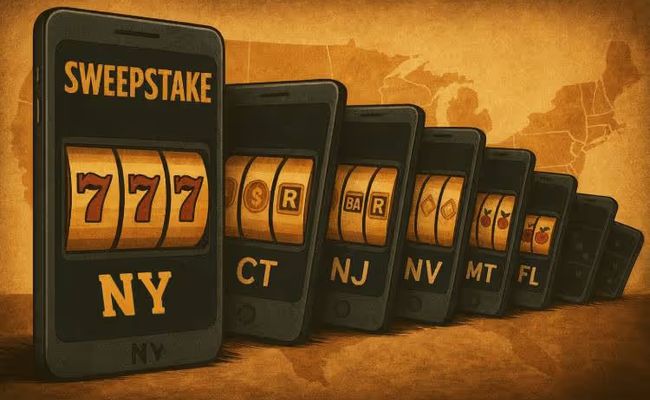
These bills arrive on top of a growing list of states that have already restricted or banned sweepstakes casinos this year. California, Nevada, Connecticut, Montana, and New Jersey all pushed through their own prohibitions. Other states, including Louisiana, West Virginia, Mississippi, and Maryland, have relied on cease-and-desist orders to force operators out without passing new laws.
Sweepstakes operators have attempted a variety of pivots to stay active in key markets. Some have redesigned their interfaces, adjusted currencies, or shifted marketing toward “training tools” rather than casino-style gameplay. Those attempts have had mixed results.
One of the clearest examples is ClubWPT Gold, which reworked its platform this year to emphasise poker training and analysis tools. Despite the overhaul, the New York ban still applied. When the law took effect, all New York users were immediately locked out and directed to redeem balances only in neighbouring states.
Other operators took a more traditional approach, shutting down in phases throughout the year. VGW, operator of Chumba Casino, LuckyLand Slots, and Global Poker, had already left New York and exited the Canadian market to focus resources on U.S. states where sweepstakes gaming remains legal.
Why Sweepstakes Casinos Are Losing Ground
The dual-currency model, which uses a free currency for gameplay and a premium currency to enter sweepstakes for cash prizes, has operated for years in a grey area between social gaming and gambling law. Regulators across the country have increasingly concluded that the format too closely replicates traditional casino play without falling under gambling oversight.
As more states introduce formal definitions of what qualifies as internet gambling, sweepstakes games have become a primary target. The general trend indicates states are seeking clearer boundaries among social gaming, promotional sweepstakes, and unlicensed gambling.
What to Expect Going Into 2026
Although sweepstakes casinos remain legal in most of the U.S., the momentum in 2025 suggests a more challenging climate ahead. California’s statewide ban will take effect on January 1, 2026, leaving operators with a short window to prepare. Several platforms have already scheduled shutdown dates or adjusted gameplay options for California users.
However, widespread bans do not mean the end of sweepstakes gaming. In much of the country, these platforms remain the only accessible alternative to online casinos, which are legal in only a handful of states. Demand for low-cost, prize-based gaming is still strong, and operators are likely to continue exploring new formats that avoid statutory definitions of gambling.
Still, if the legislative pace continues, 2026 may become the most defining year yet for the sweepstakes casino sector.

Reviews (0)
No comments yet. Be the first to comment!